
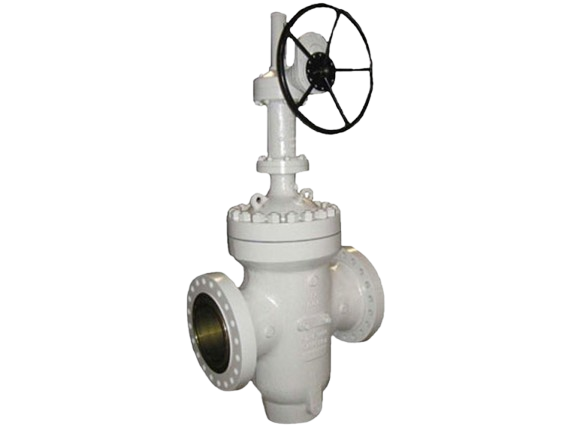
Gate Valve — Through Conduit Slab Type
Specifications
- Design standard: API 6D / ASME B16.34
- Face-to-face dimension: API 6D
- Testing standard: API 6D / ISO 5208
- Pressure/temperature rating: ASME B16.34
- Flange standard: ASME B16.5 (up to 24″) / ASME B16.47 (above 24″)
- Size range: 2″ to 48″ (DN50 to DN1200)
- Pressure class: ASME Class 150 to 1500
- Body material: WCB / LCB / LCC / CF8M / CF8 / CF3M / 4A / 6A / Inconel
- Trim material: F6a / F316 / F304 / F316L / F51 / F55 / Inconel / 17-4PH
- Seat type: Soft / metallic (floating seats)
- Stem type: Rising stem, OS&Y, non-rotating
- End connection: Flanged / butt-weld end
- Fire safe standard: API 6FA
Category Gate Valves
The Through Conduit Slab Type Gate Valve is a full bore, rising stem isolation valve with floating seats, engineered for demanding service in oil and gas transmission pipelines, onshore terminals, offshore platforms, and chemical and petrochemical processing facilities. The full port, bi-directional flow path minimises pressure drop and eliminates flow turbulence, while the through-conduit slab design positions seat faces outside the active flow stream shielding them from erosion by process fluid and extending service life across abrasive, slurry, and high-velocity applications. The valve is fully piggable, allowing pigs and scrapers to pass without risk of damage to internal components or seating surfaces.
Features
- Full bore through-conduit design keeps seat faces outside the flow stream, protecting them from erosive wear and making the valve fully piggable for inline cleaning and inspection operations
- Double block and bleed (DBB) capability provides two independent sealing barriers against the pipeline with a bleed point between them, meeting isolation requirements for maintenance and safe work procedures
- Self-relieving seats automatically vent trapped cavity pressure back to the pipeline based on differential pressure, preventing uncontrolled pressure build-up in the valve body cavity
- Fire safe construction to API 6FA, with emergency seat and stem sealant injection ports for restoring sealing integrity in the event of seat or packing damage during fire exposure
- Non-rotating stem design combined with hardfaced seating surfaces and low-emission packing options ensures long-term, low-maintenance service with bubble-tight shutoff on soft-seat configurations
- Drain and vent connections supplied as standard, with cavity pressure relief, graphite or low-emission packing, and a complete documentation package available per project specification