
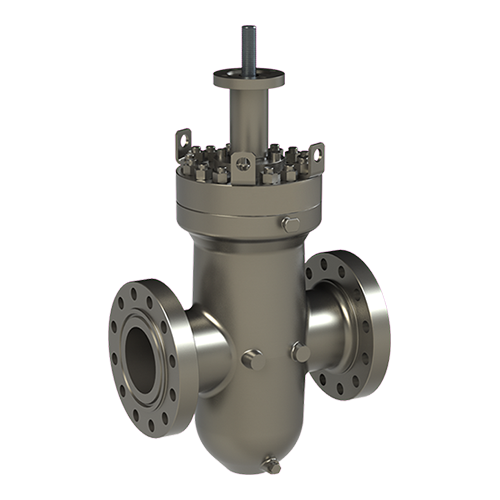
Gate Valve — Through Conduit Expanding Type
Specifications
- Design standard: API 6A / ISO 10423, API 6D / ISO 14313, API 6AV1
- Pressure rating: ANSI Class 150 to 4500 / API 2,000 to 15,000 psi
- Bore size: ½” to 56″ (subsea: ½” to 36″)
- Water depth rating: Up to 4,500m (subsea configuration)
- Body construction: Cast / forged / fabricated
- Body material: Carbon steel / low alloy steel / stainless steel / duplex / super duplex / super alloys
- Bore: Full bore / reduced bore
- Seating: Metal-to-metal / soft seat
- Sealing direction: Uni-directional / bi-directional
- Stem: Rising stem, outside screw (OS&Y)
- Seat hard facing: Tungsten carbide
- Actuation: Manual / hydraulic (FSC, FAI, FSO) / pneumatic / electric / ROV-operable
- Expanding mode: Single expanding (closed position) / double expanding (open and closed position)
The Through Conduit Expanding Gate Valve delivers Double Block and Bleed (DBB) isolation within a single valve assembly, consolidating what would otherwise require two separate slab gate valves into one compact, weight-reduced unit. The expanding gate mechanism actively drives the gate segments outward against both upstream and downstream seats simultaneously, achieving positive metal-to-metal sealing in both the open and closed positions when configured as a double-expanding valve. This makes it the preferred isolation solution for oil and gas transmission pipelines, onshore terminals, offshore surface trees, and demanding subsea applications where space, weight, and absolute sealing integrity are critical design constraints.
Features
- Double block and bleed (DBB) functionality achieved within a single valve body, eliminating the need for two conventional slab gates and delivering significant reductions in overall assembly cost, installation footprint, and weight
- Double expanding configuration seals against both seats in the open and closed positions, providing independent upstream and downstream sealing barriers with a bleed point between them for safe depressurisation and maintenance isolation
- Tungsten carbide hard-faced seating surfaces resist erosion, galling, and wear across abrasive, high-velocity, and corrosive process streams, extending seat service life beyond what softer facing materials can provide
- Available in single expanding (closed-position seal) or double expanding (open and closed seal) configurations to match the isolation philosophy of the application without over-engineering the solution
- Broad material selection across carbon steel, low alloy, stainless, duplex, super duplex, and nickel super alloys covers the full range of sour service, cryogenic, high-pressure, and corrosive process environments
- Full actuation flexibility from manual handwheel through hydraulic, pneumatic, electric, and ROV-operable configurations supports both topside and deepwater subsea deployment to 4,500m water depth